| Help The Ponheary Ly Foundation |
|
|
|
![]() The Ponheary Ly Foundation relies solely on private donations and support. Together with the tireless work of volunteers, these gifts are significantly improving the futures of the children of Cambodia. If you decide to donate, in the remarks field, please tell us if a specific program speaks to you, and we will use your donation for that effort. Donations made without a preference as to how they are to be used will be put into general funds and used where needs are the greatest. How to donate: 1. Mail us a check Make your check out to the Ponheary Ly Foundation and send to: The Ponheary Ly Foundation Post Office Box 17034 Austin, Texas 78760-7034 2. Credit or Debit Card Make a single or recurring tax effective donation using your debit or credit card: Other Ways to Support PLF
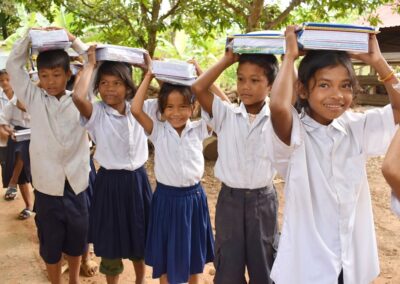
General Education Fund ![]() Providing the things necessary for children to attend school is the heart and soul of our organization. For every $20 collected, we can sponsor a child into primary or secondary school for one year. The $20 "bundle" includes the following: • One uniform and one pair of shoes, given at the start of school • A second uniform and shoes 2-3 months later • A backpack • All the school supplies for the year On the opening day of school in early October , teachers and parents help us distribute these essentials to each student. Teachers' Fund We realize one of the best ways to serve these enthusiastic and well equipped students is to support their teachers. Teachers in the rural communities typically make between $20-40 per month, depending on their education and experience. This means the teachers must often work second jobs or in the fields to subsidize their incomes, causing many absences, illnesses and a general weariness. The Foundation supports the teachers with monthly subsidies of $20-40 per month, depending on the number of sessions taught each week (for the rural teachers). We have seen a dramatic improvement in the quality of education the children are now receiving since these subsidies began. They are ![]()
Breakfast Program ![]() Children cannot learn when they are hungry. Those living in the rural communities suffer from a lack of adequate food much more than urban children do. Many children are sent to school initially in the hope that they will receive a meal each day. Tchey School has its own rice fields behind the school, which the children tend and harvest. Knar School and Koh Ker School do not. Knar School receives quarterly rations of rice and canned fish from the WFP but not enough to render adequate nutrition. PLF subsidizes these rations, securing more rice and fish from local sources, and giving the children adequate protein and nutrition six mornings per week. In addition, PLF provides a breakfast program at Koh Ker School, which does not receive such rations. ![]()
Bike to School Program PLF currently awards bicycles to students graduating from the sixth grade as well as students in grades four and five who finish first and second in their class. These bicycles both serve as incentives for students as well as necessities to continuing their education. Bicycles are often the only transportation available to not only the children, but often to their families, other than walking. Students in the countryside often walk several kilometers to get to primary school, and when they decide to continue to secondary school, it is often even further away. Children wanting to continue to the seventh grade often face a 10-15 km hike (6-9 miles), making it impossible without some sort of transportation. Donations for the bicycle program are collected all year for a big awards ceremony in August or October, depending on the school.You can read more about the Bike Program started by donor Josh Milligan here:
Medical Program ![]() Koh Ker School is located in Preah Vihear Province, near the temples of Koh Ker in Kulen District. This area is still heavily landmined, the school being in a small pocket of land cleared by cMac in just 2005. There are 124 students currently enrolled at Koh Ker in grades 1 to 3 with three teachers. This school is in an area of the country plagued with a high incidence of malaria, dengue fever and tuberculosis. It's distance (3 hours drive) from the Children's Hospital in Siem Reap make even the most minor illnesses and accidents life-threatening for the children. The Foundation has found a good friend in the person of Chuor Kim Suong, who provides medical care to all 190 children and 7 teachers. Testing kits, medicine and bandages are purchased in Siem Reap at reputable pharmacies and the doctor is at the school every day to provide medical treatment, diagnosis and education. Children who find themselves critically ill are transported to Siem Reap. In Kulen District, there are many more obstacles to educating the children than just supplies and uniforms. The obstacles are great, but pose little threat to children whose health and well being is guarded by one such as Dr. Kim. It costs the Foundation an average of $500 per month for this much needed care. You can read more about Koh Ker School here: Email us at
if you would like more information about a specific project. Thanks!
|
Donate


We realize one of the best ways to serve these enthusiastic and well equipped students is to support their teachers. Teachers in the rural communities typically make between $20-40 per month, depending on their education and experience. This means the teachers must often work second jobs or in the fields to subsidize their incomes, causing many absences, illnesses and a general weariness. The Foundation supports the teachers with monthly subsidies of $20-40 per month, depending on the number of sessions taught each week (for the rural teachers). We have seen a dramatic improvement in the quality of education the children are now receiving since these subsidies began. They are 


PLF currently awards bicycles to students graduating from the sixth grade as well as students in grades four and five who finish first and second in their class. These bicycles both serve as incentives for students as well as necessities to continuing their education. Bicycles are often the only transportation available to not only the children, but often to their
families, other than walking. Students in the countryside often walk several kilometers to get to primary school, and when they decide to continue to secondary school, it is often even further away. Children wanting to continue to the seventh grade often face a 10-15 km hike (6-9 miles), making it impossible without some sort of transportation. Donations for the bicycle program are collected all year for a big awards ceremony in August or October, depending on the school.